
Impact Story
F4D Advances Digital Remittances
What are Remittances?
Remittances are defined as cross-border person-to-person payments of relatively low value, which are typically recurrent, sent by migrant workers. Usually, remittances are sent to support the financial needs of the recipient's family or friends back home. In 2022, remittance flows to low- and middle-income countries reached a staggering US$647 billion.

Why is it Important?
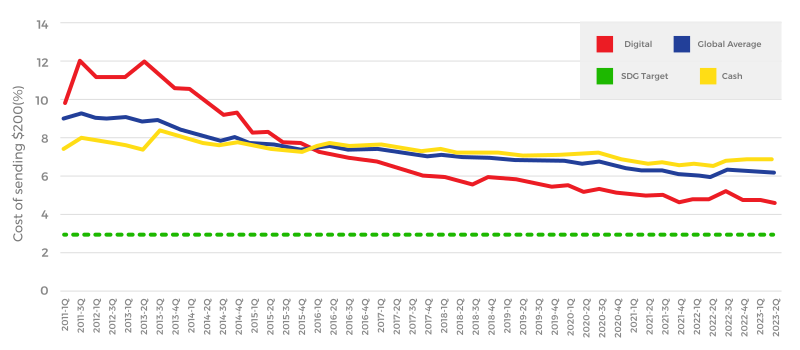
The cost to consumers of remittances transactions is expensive relative to the incomes of migrant workers which are often low, the amounts sent, and the income of remittance recipients. Since the start of monitoring remittance costs via the World Bank’s RPW database, an estimated US$235 billion was saved due to a reduction in the global average cost from 9.4 percent in 2009 to 6.2 percent in 2023. This added income could then provide remittance beneficiaries more opportunity for consumption, savings, and investment in local economies. Any reduction in remittance prices would therefore have a significant effect on the income levels of remittance families.
Remittance prices are high for many reasons, including underdeveloped financial infrastructure in some countries, limited competition, regulatory obstacles, lack of access to the financial sector by remittance senders and/or receivers, and difficulties for migrants to obtain the necessary identification documentation to enter the financial mainstream.
SDG Target:
By 2030, reduce the transaction costs of migrant remittances to less than 3%
How is F4D Supporting the Agenda?
F4D launched the Remittances and Payments Program (RPP) 2.0 to support countries to lower the cost of remittances through global knowledge generation and technical assistance for providers of remittance services at a local level, along with NGOs, local authorities, and regulators to strengthen the foundations for remittances and cross-border payment systems.
Global Knowledge
Steady progress has been made in knowledge generation on remittances as one of the World Bank’s corporate contributions to the SDGs. The World Bank is the custodian agency responsible for monitoring the UN SDG indicator 10.c.1: “By 2030, reduce to less than 3 percent the transaction costs of migrant remittances and eliminate remittance corridors with costs higher than 5 percent.”
F4D funds the World Bank’s data collection and reporting on remittance costs through the RPW Database, which is the only consistent source of data across countries and over time on a global basis. Most recently, RPW was included as part of the measurement framework for the G20 Roadmap for Enhancing Cross-Border Payments. During FY23, quarterly data updates and reports have been fully on track and are expected to continue as one of the World Bank corporate commitments. Progress has also been made in the area of remittances, including launching research on the role of FX margins in remittance costs and on improving cross-country comparability of RPW indicators. Knowledge products will continue to be produced in future years based on discussions with World Bank internal stakeholders and donors, and they are expected to benefit World Bank operations.
Under the Western Balkans Remittances and Payments Program 2.0, significant progress has been made in extending technical assistance to three countries to enhance financial inclusion. As planned, the team successfully delivered technical assistance to the Bank of Albania in drafting secondary regulations for the Payment Services Law. Similarly, technical assistance was provided to the Central Bank of Kosovo in drafting the Payment Services Law. The program also delivered technical assistance to the National Bank of Montenegro to establish a working group for regulating cryptoassets.
In Haiti, despite the extremely challenging environment, advancements have been made under the Digital Financial Services and Remittances Project, supported by F4D, to facilitate access to advances in several areas to promote access to digital payments and remittances for households.
A comprehensive diagnostic on the payment systems and the legal, regulatory, policy, and infrastructural eco-system on remittances was shared with the Central Bank in June 2023. This provides a detailed analysis of the current state of payment systems and identifies areas for improvement. The diagnostic will help the Government of Haiti assess which DFS infrastructural investments they should prioritize, and some of them may be financed by the Haiti Digital Acceleration Project. These, in turn, will contribute to the creation of an enabling environment for the digitalization of remittances.
Additionally, the team supported the Central Bank in drafting the national payment systems law and the payment systems providers’ bill addressing digital termination of remittances and tiered account openings/basic transaction accounts. The team also developed a policy note on foreign exchange margins for remittances, following the exchanges with the Central Bank.
The Ukraine Remittances and Payments Program 2.0 builds on the achievements and lessons learned from the initial phase of the program spanning 2018 to 2022. This program seeks to bolster financial inclusion in Ukraine by advocating for the adoption and use of digital payments, remittances, and other digital financial services.
Despite the challenges posed by the war in Ukraine, significant headway has been achieved in project implementation. One significant achievement is the provision of technical assistance to the National Bank of Ukraine in revising legal drafts for alignment with the Single Euro Payments Area. This technical assistance was jointly funded by the Swedish International Development Cooperation Agency Trust Fund for Ukraine.
In Morocco, the Remittances and Payments Project conducted in-depth research on barriers to electronic payment adoption with an analysis of policy options and incentives. The next step is to draft the retail payment strategy, which will include a roadmap to increase the usage of digital payments. Its recommendations will inform the Second National Financial Inclusion Strategy. Building on the insight from the research, the Digital Finance for Morocco’s Economic Transformation Project initiated support on an experimental proof of concept on the retail Central Bank Digital Currency.