Impact Story
Transforming Indonesia’s Financial Sector Through Inclusive Digital Solutions



Challenges
The FIE Program targeted three critical challenges within Indonesia’s financial sector:
Outdated Financial Supervision: Financial oversight was inefficient due to inadequate supervisory frameworks. The Financial Services Authority (Otoritas Jasa Keuangan, or OJK) needed to transition toward more automated, data-driven approaches to strengthen its oversight and risk management.
Limited Use of Transaction Accounts: Nearly half of Indonesian adults lacked access to a transaction account, limiting their ability to save, invest, and protect against financial shocks. Physical barriers and low financial literacy contributed to the challenge, particularly among social assistance beneficiaries.
Lack of a Digital ID System: Without a robust digital ID framework, online transactions—including banking and government payments—faced increased risks of fraud and inefficiency. It also hindered the country’s move toward a digital economy.
Approach
To address these challenges, the F4D grant financed key initiatives:
Enhanced Financial Sector Supervision: New "Design Thinking for Big Data Analytics" documents were developed to help OJK shift from manual to automated supervision in the capital market, insurance, and pension fund sectors. The documents identified patterns, trends, anomalies, and risks to improve the efficiency, accuracy, and speed of data usage in these three sectors.
Central Mapper Development: The new Central Mapper was developed as a critical component of Indonesia's Government-to-Person (G2P) 4.0 reform to ensure better targeting and efficiency. This tool enables beneficiaries to choose how they receive social assistance and improves the distribution of payments through transaction accounts.
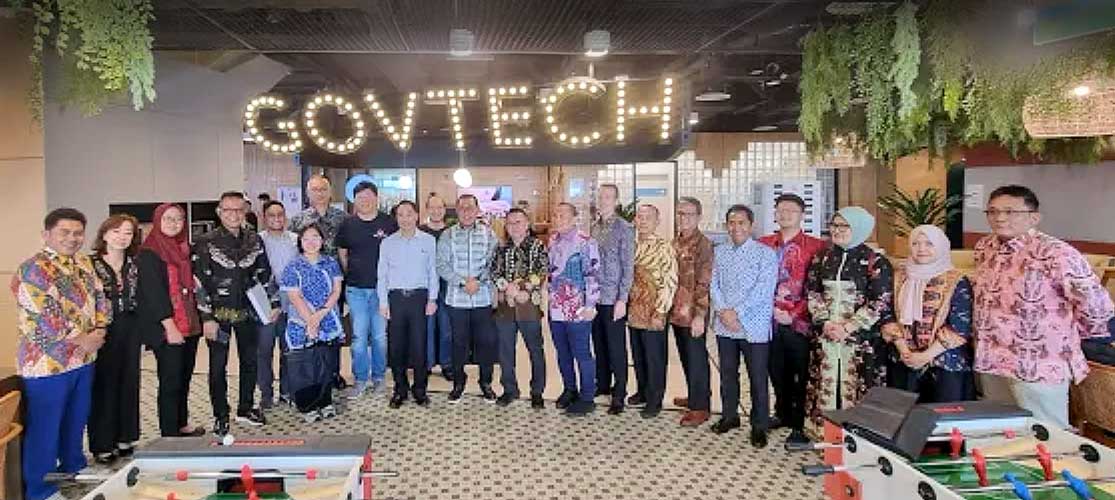
Knowledge Exchange Program with Singapore: A collaboration with Singapore gave the Government of Indonesia insights into Singpass, the country’s national digital ID system, which allows residents to securely sign in and access a range of financial services. The visit underscored the benefits of private-sector partnerships, particularly in cybersecurity.

Results
The FIE program delivered significant improvements across Indonesia’s financial sector:
More Efficient Supervision: The World Bank team’s technical advice helped OJK transition from manual onsite supervision to automated off-site supervision. This shift enhanced the speed and accuracy of OJK's supervisory capabilities.
Informed Policy Decisions: The Central Mapper identified infrastructure gaps in policy development and implementation of the G2P 4.0 reform, which key government entities used to design the reform, testing new concepts. A new, more beneficiary-centric G2P payments distribution mechanism is expected that mainly targets women in rural areas. The G2P 4.0 design is under discussion and will be implemented by the new government.
Enhanced Understanding of Digital ID: The knowledge exchange with Singapore fostered a shared understanding among government entities that aligned future policies around using digital IDs for electronic Know Your Customer (eKYC) purposes. The exchange directly informed a $250 million World Bank loan approved and implemented by the Directorate General of Population and Civil Registration of the Ministry of Home Affairs to enhance registration processes, strengthen the digital ID system (Identitas Kependudukan Digital, or IKD), and develop an eKYC platform. Four regulated financial services providers are already using the IKD application for account opening, banking, and G2P payments, and the Government is in the process of adopting IKD to verify identities for G2P transactions.
The Power of Knowledge Exchange:
Applying Singapore’s Digital ID Experience in Indonesia
Indonesia’s journey toward a national digital ID system was strengthened by insights gained from a knowledge exchange visit regarding Singapore’s digital ID and eKYC initiatives. Learning from Singapore’s Singpass model, Indonesia’s Directorate General of Population and Civil Registration refined the design and work plan for its own digital ID application, including aligning with international standards, incorporating a user-centric design, and leveraging cloud technology for scalability. The exchange bolstered government confidence, accelerated project approvals, and supported Indonesia's digital government initiative (Sistem Pemerintahan Berbasis1- SPBE). It also built strong consensus around adopting the IKD and eKYC platforms for use in banking, financial services, and G2P payment transactions.
Looking Ahead
Building on the success of the FIE Program, the forthcoming F4D grant, Indonesia Inclusive Finance Program (IIFP), will continue to support OJK in the next supervisory technology arrangement, this time focused on the multi-finance sector. IIFP will also help the Government establish the necessary regulatory and policy framework and develop the Central Mapper infrastructure.
Lessons Learned
The grant succeeded in part due to stakeholders' understanding of key issues, commitment, and openness to new ideas. The knowledge exchange created a shared vision among government policymakers, which was crucial to the development and design of the program.
Identifying reform-minded policymakers as main counterparts was critical. For example, different preferences and levels of acceptance in G2P 4.0 were overcome by identifying champions within the government to rally other stakeholders and maintain momentum on the reform work.
Policy focus and collaboration were key—targeting policy topics for critical reforms in national or sectoral strategies, partnering with relevant World Bank teams to avoid a fragmented policy approach, and providing practical solutions and actionable next steps to ensure successful implementation.
The FIE Program demonstrates that with the right tools, collaboration, and committed leadership, inclusive digital finance can become a reality in Indonesia.